IBS-CGP Mini-Workshop on 2d/3d Mirror Symmetry
April 27–30, 2026
IBS POSTECH Campus
Organizers
- Sukjoo Lee (IBS Center for Geometry and Physics)
- Yan-Lung Li (IBS Center for Geometry and Physics)
- Yong-Geun Oh (IBS Center for Geometry and Physics & POSTECH)
- Ju Tan (IBS Center for Geometry and Physics)
Invited Speakers
- Kifung Chan (The Chinese University of Hong Kong)
- Hyunbin Kim (The Chinese University of Hong Kong)
- Chin Hang Eddie Lam (The Chinese University of Hong Kong)
- Yan-Lung Li (IBS Center for Geometry and Physics)
- Ju Tan (IBS Center for Geometry and Physics)
Venue
IBS POSTECH Campus Bldg. #301
*For the location of the conference site, click here for google map.
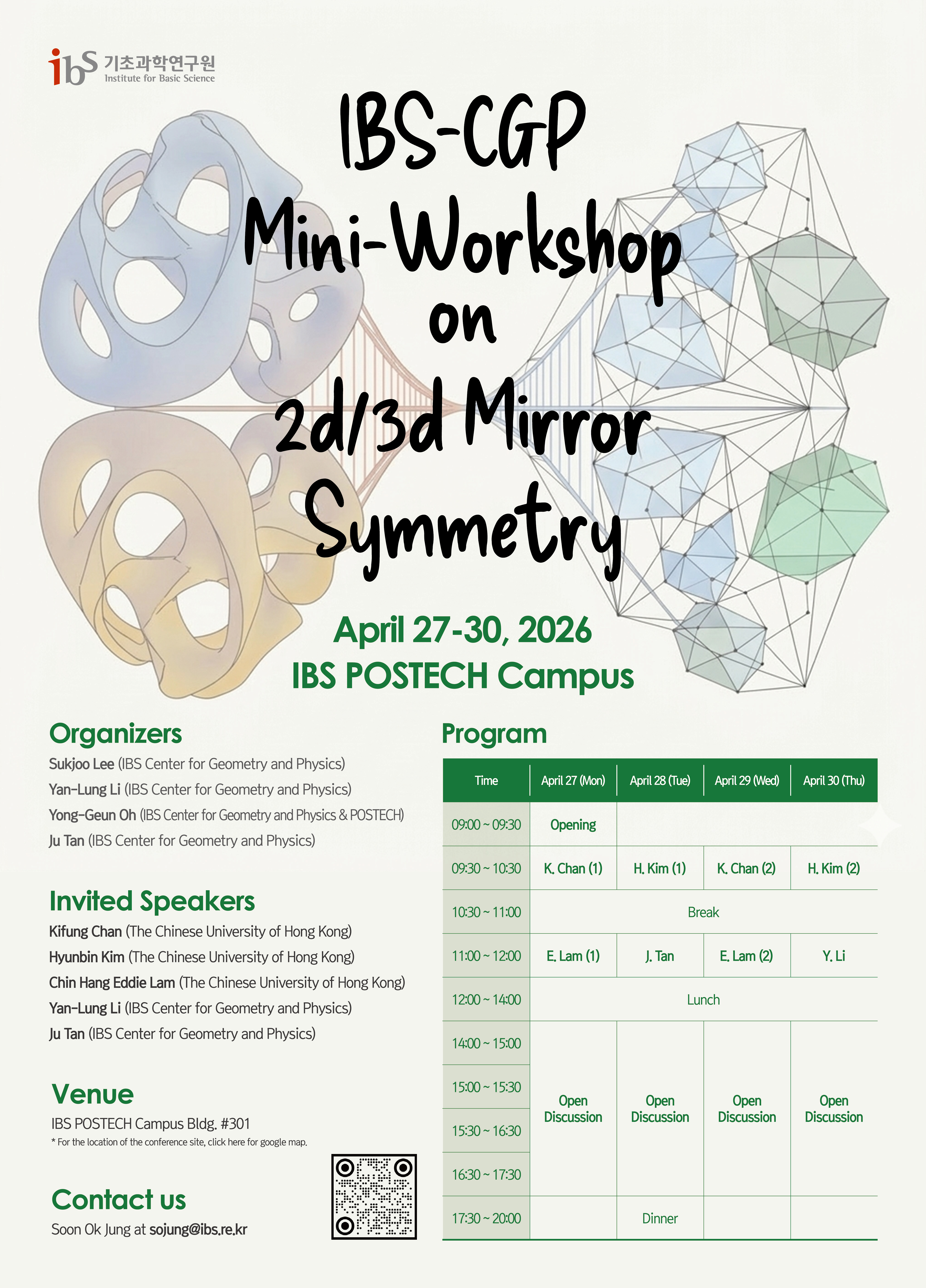
Program
| Time | April 27 (Mon) | April 28 (Tue) | April 29 (Wed) | April 30 (Thu) |
|---|---|---|---|---|
| 09:00 – 09:30 | Opening | |||
| 09:30 – 10:30 | K. Chan (1) | H. Kim (1) | K. Chan (2) | H. Kim (2) |
| 10:30 – 11:00 | Break | |||
| 11:00 – 12:00 | E. Lam (1) | J. Tan | E. Lam (2) | Y. Li |
| 12:00 – 14:00 | Lunch | |||
| 14:00 – 15:00 | Open Discussion | Open Discussion | Open Discussion | Open Discussion |
| 15:00 – 15:30 | ||||
| 15:30 – 16:30 | ||||
| 16:00 – 17:30 | ||||
| 17:30 – 20:00 | Dinner | |||
Abstract
Monday, April 27
| Time | Speaker | Title & Abstract |
|---|---|---|
| 09:30 – 10:30 | Kifung Chan (The Chinese University of Hong Kong) |
Stable basis and quantum cohomology I The stable basis is a distinguished basis in the equivariant cohomology of a class of important spaces known as conical symplectic resolutions, including hypertoric varieties, quiver varieties, and T∗(G/B). In this talk, I will give an introduction to the stable basis, emphasizing its geometric and algebraic significance. I will then discuss its role in the study of shift operators and its applications to quantum cohomology. |
| 11:00 – 12:00 | Chin Hang Eddie Lam (The Chinese University of Hong Kong) |
Coulomb branches, and geometry of shift operators I We review the construction of shift operators on equivariant quantum cohomology, and explain how this gives rise to a construction of Coulomb branch algebra action. A key feature of this action is that it is defined without localization. We explain the computation for X=G/B, which recovers the Peterson's isomorphism. Finally, we give a characterization of Coulomb branch in terms of the "non-localizing" property. |
Tuesday, April 28
| Time | Speaker | Title & Abstract |
|---|---|---|
| 09:30 – 10:30 | Hyunbin Kim (The Chinese University of Hong Kong) |
3D Mirror Symmetry and Hom Space of 3D Branes I Starting from the classical 2D SYZ mirror symmetry, I will give a brief introduction to 3D mirror symmetry through explicit examples. Building on the classical SYZ mirror construction, we review Teleman’s conjecture to examine how symmetries (symplectic quotients) are reflected under mirror symmetry and discuss its implications in the 3D setting. We then review Chan–Leung’s 3D mirror brane construction through concrete examples and examine interesting phenomena related to the Hom spaces of these branes. |
| 11:00 – 12:00 | Ju Tan (IBS Center for Geometry and Physics) |
Extended Localized Mirrors and Koszul Duality Localized mirror constructions use Maurer–Cartan deformations of the Fukaya A_infty-algebra of a Lagrangian brane to produce local charts of the mirror, typically via formal parameters associated to degree-one deformation directions. This raises the question of whether one can construct a richer deformation space that incorporates the full Floer complex. Such considerations motivate the notion of extended localized mirrors, introduced in Cho–Hong–Lau. In this talk, I will explain that the extended localized mirror can be identified with the Koszul dual of the A_infty-algebra of the underlying Lagrangian immersion, and discuss the emerging Koszul-dual pattern in local mirror symmetry. This talk is based on ongoing joint work with Hansol Hong and Siu-Cheong Lau. |
Wednesday, April 29
| Time | Speaker | Title & Abstract |
|---|---|---|
| 09:30 – 10:30 | Kifung Chan (The Chinese University of Hong Kong) |
Stable basis and quantum cohomology II The stable basis is a distinguished basis in the equivariant cohomology of a class of important spaces known as conical symplectic resolutions, including hypertoric varieties, quiver varieties, and T∗(G/B). In this talk, I will give an introduction to the stable basis, emphasizing its geometric and algebraic significance. I will then discuss its role in the study of shift operators and its applications to quantum cohomology. |
| 11:00 – 12:00 | Chin Hang Eddie Lam (The Chinese University of Hong Kong) |
Coulomb branches, and geometry of shift operators II We review the construction of shift operators on equivariant quantum cohomology, and explain how this gives rise to a construction of Coulomb branch algebra action. A key feature of this action is that it is defined without localization. We explain the computation for X=G/B, which recovers the Peterson's isomorphism. Finally, we give a characterization of Coulomb branch in terms of the "non-localizing" property. |
Thursday, April 30
| Time | Speaker | Title & Abstract |
|---|---|---|
| 09:30 – 10:30 | Hyunbin Kim (The Chinese University of Hong Kong) |
3D Mirror Symmetry and Hom Space of 3D Branes II Starting from the classical 2D SYZ mirror symmetry, I will give a brief introduction to 3D mirror symmetry through explicit examples. Building on the classical SYZ mirror construction, we review Teleman’s conjecture to examine how symmetries (symplectic quotients) are reflected under mirror symmetry and discuss its implications in the 3D setting. We then review Chan–Leung’s 3D mirror brane construction through concrete examples and examine interesting phenomena related to the Hom spaces of these branes. |
| 11:00 – 12:00 | Yan-Lung Li (IBS Center for Geometry and Physics) |
Seidel representations and obstructions of Lagrangian correspondences Seidel representation $\mathcal{S}$ is an important enumerative invariant which provides interesting relations between Hamiltonian diffeomorphism group $\mathrm{Ham}(X)$ and quantum cohomology $QH(X)$ of a symplectic manifold $X$, obtained from counting pseudoholomorphic sections of the Seidel space $E_\gamma$ associated to a Hamiltonian loop $\gamma \in \pi_1(\mathrm{Ham}(X))$. In this talk, we will discuss an ongoing joint work with Lau and Leung on resolving a conjecture of Teleman on identifying $S$ with Teleman's mirror fibration $F$ under the closed-string mirror symmetry of $X$, when $\gamma$ generates a Hamiltonian $\mathbb{S^1}$-action. This generalises a result of Chan-Lau-Leung-Tseng when $X$ is toric semi-Fano. A key ingredient of the proof is the equivariant Floer theory of a Lagrangian correspondence $L$ between $E_\gamma$ and $X$ as a symplectic quotient of $E_\gamma$, based on an earlier joint work with the same authors. Time permitting, we will discuss the unobstructedness of $L$ after bulk deformation by $S$ (modulo higher-order terms). |
Contact
Soon Ok Jung (sojung@ibs.re.kr)